
As healthcare regulations and utilization patterns evolve for 2026, payers face significant changes that will impact reimbursement strategies and fraud, waste, and abuse (FWA) prevention. Confirmed and proposed federal regulations have introduced permanent telehealth flexibilities, new remote patient monitoring codes, and sweeping updates to skin substitute reimbursement and DMEPOS accreditation. These changes create opportunities for improved care delivery but also new challenges in compliance and FWA management.
Here are three key shifts for payment integrity and compliance teams to monitor as the new year gets underway.
Telehealth and remote patient monitoring: Expanded access, higher stakes
Telehealth is no longer a temporary pandemic-era solution—it is now a cornerstone of Medicare’s care model, with Medicare visits conducted through telehealth increasing from approximately 840,000 in 2019 to 52.7 million in 2020, according to the Department of Health and Human Services. The Centers for Medicare & Medicaid Services (CMS) has relaxed frequency limits for inpatient, nursing facility, and critical care telehealth visits, enabling providers to deliver virtual consultations based on clinical need rather than arbitrary caps.
In addition, CMS now treats all telehealth services meeting new criteria as permanent, unifying provisional and permanent codes. Direct supervision can now occur via real-time audio-video technology, and behavioral telehealth has expanded with new codes for collaborative psychiatric care, group counseling, and select digital mental health tools. Finally, audio-only telehealth remains permissible for behavioral health when properly documented by providers, using Modifier 93 and noting why video was not feasible.
While these changes enhance access and continuity of care, they also increase complexity and risk. Payers must monitor for documentation gaps, coding errors, and patterns indicative of abuse—such as excessive 60-minute sessions, overlapping appointments, and uniform upcoding. As seen in Figure 1, claim data analyzed by Cotiviti indicates a noticeable increase in 60-minute sessions billed in recent years with a corresponding decrease in 45-minute sessions.
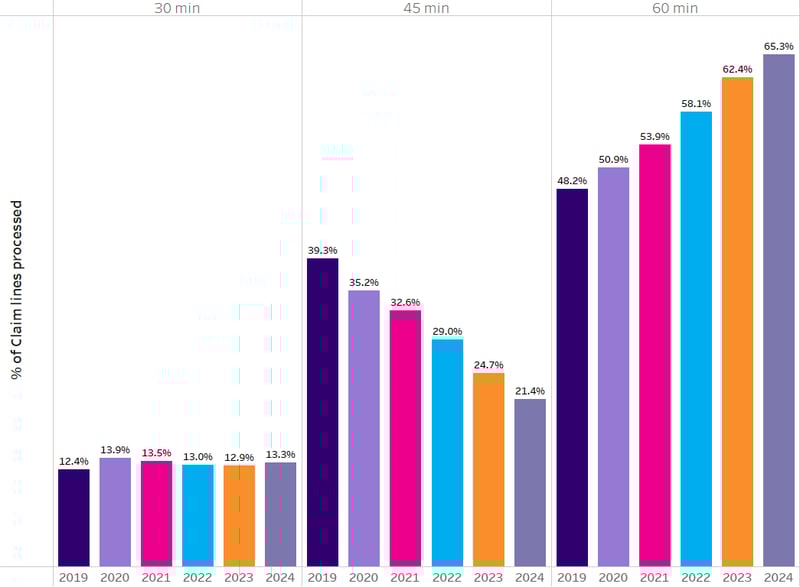
Figure 1. Behavioral telehealth claim trends, 2019–2024.
Remote patient monitoring (RPM) is also growing and evolving. About 4,600 medical practices routinely billed for remote patient monitoring in 2024 according to the HHS Office of Inspector General (OIG), with approximately five new practices added each month. CMS is introducing new RPM codes for shorter monitoring periods (2–15 days) and reduced clinician interaction time (10 minutes), enabling legitimate acute-episode monitoring.
These changes support innovation but also open doors to potential abuse. Common schemes include billing for multiple monitoring devices per month for a single member, rapid increases in the number of members billed for, and billing for a high number of members with no history with the practice. Payers should update policies to require evidence of a provider-patient relationship before device deployment and define acceptable interactive communication standards, such as real-time audio/video rather than text messaging.
Skin substitutes: A fundamental shift in reimbursement strategy
CMS is implementing one of the most significant payment reforms in recent years by moving skin substitute reimbursement away from product-specific rates to a standardized “incident-to” supply model. This change is designed to dismantle financial incentives that have historically driven overutilization of high-cost biological products. Under the new framework, most skin substitutes will be grouped by FDA regulatory pathway—Pre-Market Approval (PMA), 510(k) devices, and Human Cells, Tissues, and Cellular and Tissue-Based Products (HCT/P)—and paid at a single, uniform rate of approximately $127.28 per square centimeter. By simplifying payment structures and reducing variability, CMS aims to curb unnecessary spending and promote clinical appropriateness, projecting a nearly 90% reduction in Medicare costs for skin substitutes.
While this new policy can help reduce FWA, bad actors may look for ways around them. Providers may respond with creative billing tactics such as inflating quantities or substituting products within categories to offset revenue losses. Payers should anticipate these behaviors and strengthen oversight by monitoring utilization trends and validating documentation for clinical necessity. This shift underscores the importance of proactive planning and advanced analytics to safeguard payment integrity as the new reimbursement model takes effect.
DMEPOS: Policy overhaul to reduce complexity and overutilization
For durable medical equipment, prosthetics, orthotics, and supplies (DMEPOS), CMS will relaunch the competitive bidding program in 2026, introducing a Remote Item Delivery track for high-volume items like continuous glucose monitors and insulin pumps to streamline procurement. Accreditation requirements will tighten, with annual surveys and greater transparency from accreditation organizations. Mandated unannounced surveys by accreditation organizations will be implemented to better align with federal standards.
CMS also will implement a prior authorization exemption for suppliers with a 90% claim approval rate, reducing administrative burdens. This introduces potential new vulnerabilities if not monitored carefully.
Next steps for payers
The regulatory changes are not just incremental—they represent a fundamental shift in how care is delivered, documented, and reimbursed in many areas. For payers, this means moving beyond awareness to decisive action. The complexity of new telehealth flexibilities, RPM codes, and reimbursement models for skin substitutes and DMEPOS demands a proactive, coordinated approach.
Consider this action plan for the new year:
| ASAP | Next 90 days | Next 90–365 days |
|---|---|---|
|
|
|
These 2026 regulatory changes represent a paradigm shift in care delivery and reimbursement. While these updates promise improved access and efficiency, they also demand heightened vigilance. By implementing robust monitoring strategies, leveraging advanced analytics, and fostering cross-functional collaboration, payers can mitigate risks and protect payment integrity while safeguarding their members’ benefits.
Webinar: Navigating regulatory changes and FWA schemes in 2026
Dive deeper and stay ahead of potential FWA patterns that may arise in 2026. Don’t miss our latest on-demand Payment Integrity Pulse webinar as we discuss key regulatory changes and the trending schemes found in Cotiviti data that may be affected by these actions.

Krista Baisch, J.D., vice president and associate general counsel for Cotiviti, also contributed to this article.